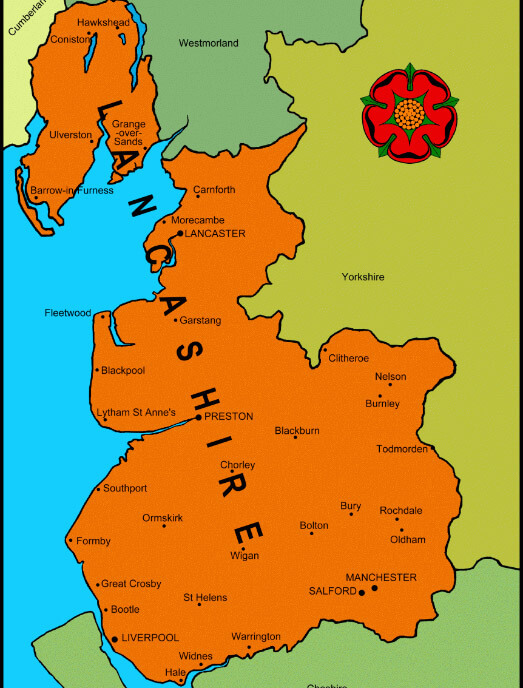
Lancashire
Gardens Trust
Local Important Parks & Gardens
Undesignated Parks & Gardens
These landscapes are classed in Category 1
Between 1994 and 1999 English Heritage carried out a programme of county-based surveys of Historic Designed Landscapes in partnership with local authorities and other locally-based organisations. The aim was to identify sites of historic and special interest. Ed. Bennis and J. Dyke from Manchester Metropolitan University School of Landscape produced the Lancashire survey in 1998:
Judith Roberts and Edna Currie produced the Greater Manchester survey in 1988 and Christopher Gallagher the Merseyside Report in 1994. In all over 930 parks and gardens have been identified, and Lancashire Gardens Trust aims to survey and research these sites in more detail. Some have already been wholly or partly ‘lost’, but they can be fully recorded and information made available.

Bailrigg House, Scotforth, Lancaster
A Thomas Mawson design for Herbert Storey in 1906, over a wider landscape by H.E. Milner

Cathedral Court and Square Blackburn
A project for the Dean and Chapter completed in 2016 by Purcell with the landscape architect PlanIt.

Broadoak, Accrington
A Thomas Mawson design for Sir George McAlpine in 1900; the architect and Mawson worked together to make a complementary whole.

Browsholme Hall, Clitheroe
Home of the Parker family since the earliest records. Sir Jeffry Wyatville altered the house and possibly the landscape for Thomas Lister Parker in 1804.

Calder Vale, Brock
A model textile community based on a cotton mill, chapel, cottages and temperance hotel. All sit beside the river Calder.
Built in 1835 for Quaker manufacturers R & J Jackson.

Claughton Hall, Garstang
A park in the natural style with sinuous lake, winding approach, copses and ribbons of trees. C19 plantations, stables and walled garden.
A design possibly by William Emes (1729-1803) for the Fitzherbert family, still in residence.

Greenthorne, Edgworth, Bolton
An Arts & Crafts house and garden; the ornate, stepped terrace overlooks a wider landscape with stream and lake.
A Thomas Mawson design for cotton manufacturer J. Barlow in 1912.

Gresgarth Hall, Caton, Lancaster
An extensive garden in the English classical style featuring many aspects of the designer’s art. A romantic streamside setting.
A Picturesque site of c.1805 now developed in great beauty by award-winning designer Arabella-Lennox-Boyd.

Hazelwood, Silverdale
A lavish stepped terrace in limestone incorporates a wall fountain, loggia and rose garden. An L-shaped pergola leads away from it, with views to the sea.
A Thomas Mawson design for the Sharp family in 1920; an older house was re-modelled in Italianate style to complement the garden.

The Holme, Cliviger
An estate created in a steep valley, planted to afford walks in the plantations and across the stream in Picturesque style.
Created by Dr. Thomas D. Whitaker (1759-1821), antiquarian and author. He probably introduced the artist JMW Turner to Lancashire.

Hornby Castle, Hornby
A C12 castle stood on this hilltop to command views over the river Lune. Each century has seen additions to this dramatic site, painted by Turner.
Seat of the Lords of the Manor of Hornby and Tatham. In C19 the architects Paley & Austin extended the castle and terrace.

Knowlmere Manor, Slaidburn
A Picturesque landscape of plantations, walks and pasture with views to the river Hodder.
Estate created in 1805 for J. Peel, manufacturer, son of Sir Robert; a new house was built in 1845 with stables and walled garden.

Leighton Hall, Carnforth
A Picturesque landscape of pasture and plantations; the limestone hall in gothic style lies in a bowl with a backdrop of Cumbrian mountains.
Records survive from 1246; George Townely built a house in 1763 and probably laid out the park. The Gillow family, of furniture fame, have resided here since 1822.

Quernmore Park, Caton
A deer park overlaid by a landscape park and a later elaborate Victorian walled garden.
John Webb (1754-1828) designed the park in the natural style. He had several Lancashire commissions.

Rufford New Hall, Rufford
A deer park overlaid by a late C18 formal landscape with avenues in a patte d’oie. Natural-style landscaping did not eliminate all of it. C20 hospital gardens were elaborate and colourful.
Plans of 1735 for the Hesketh family survive; Thomas Dalrymple Hesketh moved parts of Rufford village in late C18 to extend the park.

Skelmersdale New Town
A town designed around the river Tawd where compact urban and industrial areas are separated by green sites for recreation.
In 1961 the site was chosen to relieve overcrowding in north Merseyside; Sir LH Wilson drew the masterplan, preserving the historic Ashurst Beacon.

Turton Tower, Bolton
An early (1431) manor and estate overlaid by a C17 garden still in evidence. The railway company was required to cross the land via a tunnel (1847-8).
Families associated include the Orrells, Humphry Chetham and James Kay, inventor of a successful process for spinning flax.

University of Lancaster
A combined design of buildings and landscape form a campus of linked courtyards and walkways.
Messrs Bridgewater, Shepheard & Epstein collaborated on the layout in the early 1960s.

Westfield War Memorial Village, Lancaster
A community of houses lining radiating avenues, social centre, bowling green and (originally) workshops; a bronze statue stands at the centre as the memorial.
Designed and built by Thomas Mawson & Sons to Arts & Crafts principles 1922-4; funded by donation and lottery to house the returning wounded after 1918.

Whalley Abbey precinct
Abbey grounds lie beside the river Calder in the town.
Founded in 1296, the buildings became the private dwelling of the Assheton family in Tudor times. In C19 the Hargreaves, calico printers, adapted the precinct to a sublime Picturesque landscape.

Winckley Square, Preston
A remarkable surviving square surrounded by Georgian town houses; formerly arranged in narrow plots and now one open space.
Begun in 1799 by W. Cross and modelled on squares in London and Bath. Residents have recently promoted its restoration.

Wyresdale Park, Scorton
Mid-Victorian sporting estate and home farm, with remains of extensive glass-houses; wider parkland and arboretum. Former parterre in Italianate style.
Purchased from the Duke of Hamilton in 1853 by P Ormrod, cotton spinner. House in gothic style by E Paley.
Lancashire Gardens Trust
Regd. Office: Moss Lane House, Green Lane, Chipping, Preston. PR3 2TQ
Company No. 07097219
Charity No. 1164494
© 2023 LGT.
The Lancashire County Palatine